
what that bunch of flowers really says ..
Floral extracts are increasingly part of the beauty firmament - and not just for NATURAL brands. While aromatherapy and BOTANICAL brands have long used the ESSENCE extracted from the PETAL, leaf and stalk of flowers to give their products natural beauty BENEFITS, the rest of the business has been playing CATCH-UP- looking for sophisticated ways to use plant extracts in high-tech anti-ageing formulas. One ENTERPRISING brand founder, whose line launches later this year, has used extracts from a shrub called THE LIPSTICK TREE to give her lipsticks conditioning and colouring POWERS.
But did you know that flowers also have a HIDDEN MEANING? And that the bunch of flowers someone gives you may have been composed to pass on a SECRET message?
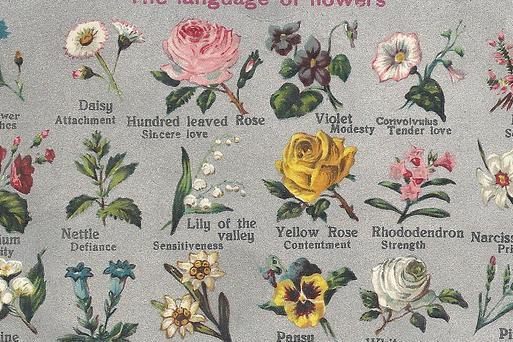
The language of flowers, sometimes called floriography, was a Victorian-era means of communication in which various flowers and floral arrangements were used to send coded messages, allowing individuals to express feelings which otherwise could not be spoken.
This language was most commonly communicated through tussie-mussies (small flower bouquets), an art which has still a following today. The subtle nuances of the language are now mostly forgotten, but red roses still imply passionate, romantic love and pink roses a lesser affection; white roses suggest virtue and chastity and yellow roses still stand for friendship or devotion. Also commonly known meanings are sunflowers, which can indicate either haughtiness or adoration.
The notion of plants having meanings is traditional, as seen for example in the 17th century play Hamlet in the passage beginning, “There’s rosemary, that’s for remembrance,…”
The 19th century interest in a language of flowers finds its roots in Ottoman Turkey, specifically the court in Constantinople and an obsession it held with tulips during the first half of the 18th century. The craze was then introduced to Europe by two people – Mary Wortley Montagu, who introduced it to England in 1717, and Aubry de La Mottraye, who introduced it to the Swedish court in 1727. This was then eventually popularized in various European countries – in Britain and France, it was popular during the first part of the 19th century, via such books as Le Langage des Fleurs by Charlotte de Latour.
The symbolism of some flowers:
Acacia – Secret love
Agrimony – Thankfulness
Ambrosia – Love is reciprocated
Anemone – Forsaken, anticipation, unfading love
Arbutus – “You’re the only one I love”
Baby’s breath – Innocence, pure of heart
Balsam – Ardent love
Bellflower – Disappointment, loss
Bells of Ireland – Luck
Bird of Paradise flower – Liberty, magnificence, good perspective, faithfulness (given by a man to a woman)
Borage – Courage
Canterbury Bells – Gratitude
Red carnations – Deep romantic love, passion, “My heart aches for you,” “Alas; for my poor heart!”
Pink carnations – A woman’s love, a mother’s love, “I’ll never forget you,” “Always on my mind,”
Yellow carnations – rejection, disdain, “You have disappointed me”
Coriander – Lust
Daffodil – Uncertainty, chivalry, respect or unrequited love, return my affection
Daisy – Innocence, loyal love, purity, faith, cheer, simplicity; or, dissembling as in Shakespeare’s Hamlet
Gorse – Love in all seasons
Heliotrope – Devotion
Honeysuckle – Devoted affection, bonds of love
Iris – Good news
Ivy – Dependence, endurance
Lavender – Devotion, distrust
Lettuce – Cold-hearted
Mint – Suspicion
Morning glory – Love in vain
Narcissus – Unrequited love, selfishness
Oak leaf – Strength
Olive – Peace
Red rose – True love
Black rose – Death, hatred, farewell, rejuvenation or rebirth
Lavender (violet) – Love at first sight
Sweetpea – “You have my thanks”
Violet – Faithfulness
Willow – Love forsaken
Wheat – Wealth and prosperity


